
Developer
API Key
software developer
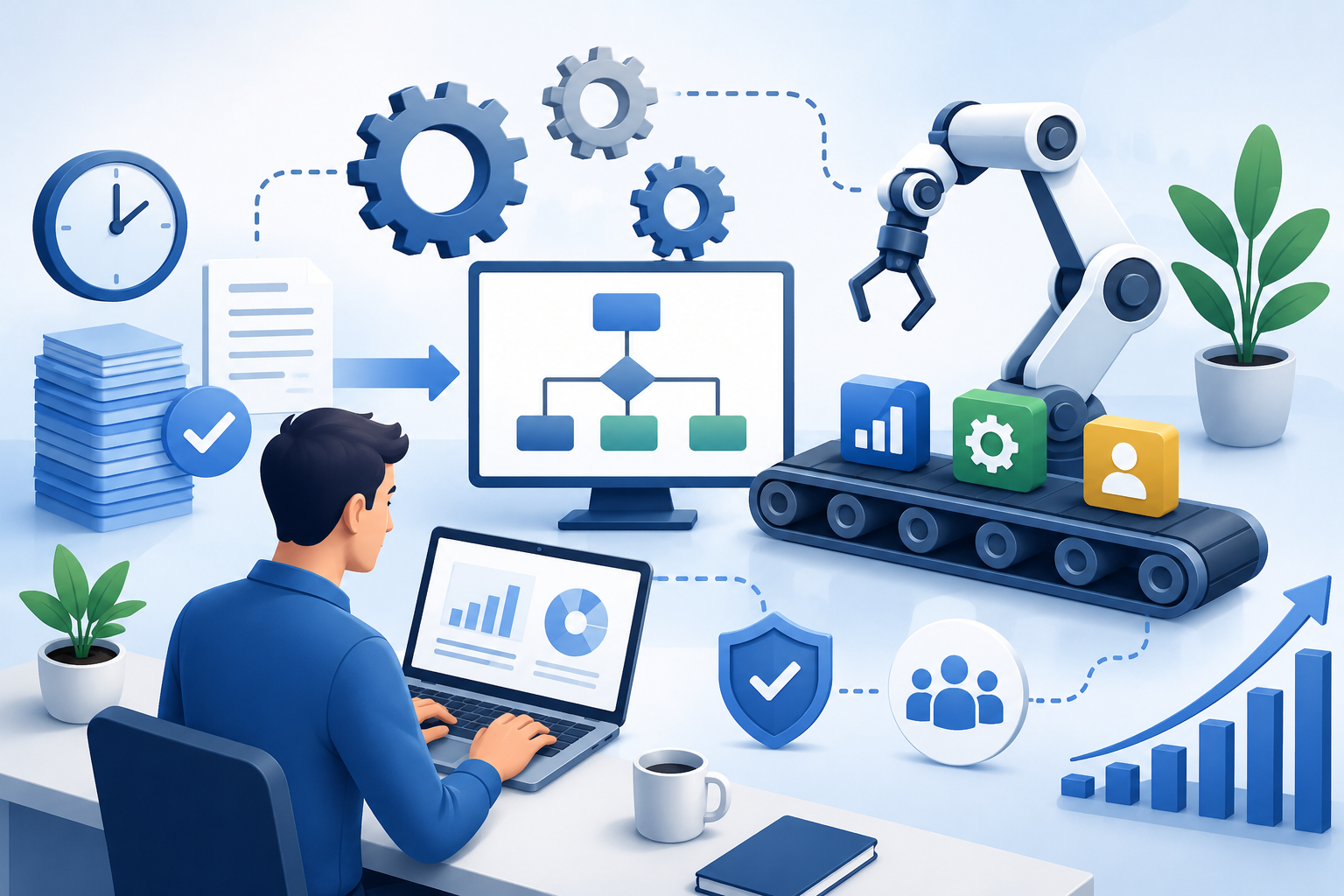

Every business wants to save time, reduce costs, and improve productivity. However, repetitive manual tasks often slow operations and increase the chances of human error. This is where process automation becomes a game changer. It helps organizations automate routine workflows, allowing employees to focus on strategic and creative work instead.
Process automation uses software, digital tools, and predefined workflows to perform repetitive business tasks without constant human intervention. Instead of manually completing every step, automation software follows rules and triggers actions automatically.
For example, when a customer submits an online form, the system can:
Businesses of all sizes can gain significant advantages by implementing automation.
Employees spend less time on repetitive work and more time on high-value activities that require critical thinking and decision-making.
Automated workflows follow predefined rules, ensuring greater consistency and minimizing costly mistakes.
Routine approvals, document processing, and customer responses happen much faster than manual methods.
Automation reduces labor-intensive tasks, helping businesses optimize resources and lower operating expenses.
Quick response times and accurate service delivery improve customer satisfaction and strengthen business relationships.
While process automation covers the automation of entire workflows, robotic process automation (RPA) specifically uses software bots to mimic human actions within digital systems.
These bots can:
Unlike traditional automation, robotic process automation can work across multiple software platforms without requiring major system changes. Consequently, many organizations use RPA as a practical first step toward digital transformation.
Today, automation is transforming nearly every industry.
Healthcare
Automates appointment scheduling, billing, patient records, and insurance processing.
Finance
Speeds up loan approvals, fraud detection, compliance reporting, and payment processing.
Manufacturing
Improves inventory management, production scheduling, and quality control.
Retail
Automates order processing, inventory updates, customer support, and returns management.
Human Resources
Simplifies recruitment, onboarding, payroll, and employee record management.
Implementing automation requires careful planning. Consider these best practices:
Many businesses struggle to identify where automation will have the greatest impact. This is why professional IT service and consulting firms play an important role.
Experienced consultants help businesses:
As businesses continue to embrace digital transformation, process automation has become essential for improving efficiency, reducing costs, and delivering better customer experiences. Partnering with trusted IT service and consulting experts ensures a smooth automation journey, helping businesses implement scalable solutions that drive long-term growth, operational excellence, and sustainable success.
Process automation is the use of software and digital technologies to automate repetitive business tasks and workflows, improving efficiency, accuracy, and productivity.
Process automation focuses on automating complete business workflows, while robotic process automation uses software bots to perform repetitive digital tasks by mimicking human actions.
Professional IT service and consulting providers help businesses identify automation opportunities, implement the right technologies, integrate systems, and ensure long-term success with minimal risk.
